Last-Minute New Year Email Marketing Checklist
SanitizeEmail•02 Jan 2026•5 min Read
The New Year is one of the few moments when inbox behavior resets. Subscribers are closing one chapter and opening another, which makes early January a valuable window for email marketers - if campaigns are executed carefully.
If you’re short on time, this last-minute New Year email marketing checklist focuses on high-impact actions you can still take to protect deliverability, improve engagement, and start the year on the right foot without rebuilding your entire email strategy.
If you want a reference point for the types of SaaS and software promotions companies typically run around this time, our Christmas & New Year SaaS and software deals roundup highlights promotion patterns across both periods for comparison.
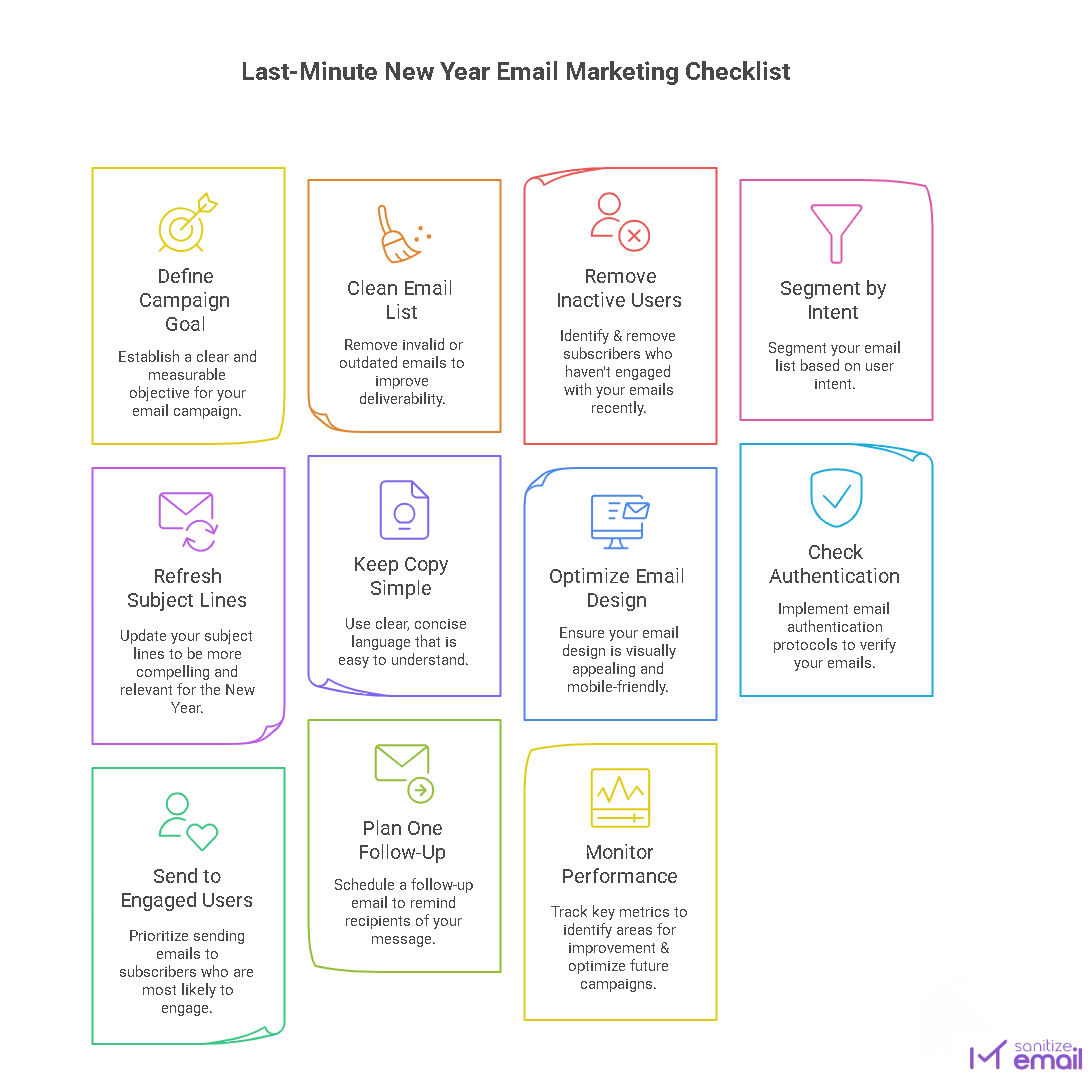
Before touching copy or design, decide what this email is meant to achieve.
Most New Year emails fall into one category:
Trying to achieve multiple goals in a single email usually leads to weak results. A focused message performs better.
The start of the year is not the time to gamble with list quality.
Before sending:
If you need to validate a large list quickly, tools like SanitizeEmail can help identify invalid, disposable, and risky email addresses before you send.
Starting January with a clean list protects your sender reputation for the months ahead. This step works best when it’s part of a consistent email hygiene process, not just a one-time cleanup.
Not every subscriber from last year should receive your first New Year email.
Review engagement from the past 60–90 days:
Sending first to engaged users helps establish strong sender signals early in the year. Managing inactive subscribers is a core part of long-term email hygiene and list health.
New Year intent varies widely.
Segment subscribers based on:
Relevance matters more than reach during early-year campaigns.
New Year subject lines should feel forward-looking, not aggressive.
Best practices:
Examples of effective New Year angles:
January inboxes are still crowded.
For better engagement:
Long explanations and multiple CTAs reduce clarity and clicks.
Heavy designs hurt performance, especially early in the year.
Before sending:
Lightweight templates often outperform complex designs during New Year campaigns.
New Year campaigns often involve renewed or increased send volume.
Double-check:
Infrastructure issues early in January can impact deliverability for weeks.
If you plan multiple New Year emails:
This reduces risk and stabilizes performance.
Not everyone opens the first message.
Plan:
Avoid sending multiple reminders - one is usually enough.
New Year campaigns set the tone for the year.
Track:
Use these insights to adjust your January and Q1 email strategy.
If you’re working with limited time, focus on the actions that deliver the biggest impact with minimal effort:
These quick adjustments won’t replace proper planning, but they can significantly improve results when time is tight.
Last-minute New Year email marketing doesn’t have to be rushed or risky. By focusing on list quality, segmentation, clarity, and deliverability, you can still run effective campaigns even with limited preparation time.
The New Year is less about aggressive promotion and more about setting expectations and rebuilding momentum. Start strong, protect your sender reputation, and build a foundation for consistent engagement in the months ahead.