Email Hygiene: How Often You Should Clean Your Email List (With Real Examples)
SanitizeEmail•22 Jan 2026•5 min Read
Email hygiene is the ongoing practice of keeping your email list accurate, active, and safe to send to over time. It directly impacts bounce rates, inbox placement, and sender reputation, and it’s not something that can be handled with a one-time cleanup.
One of the most common mistakes teams make is verifying a list once and assuming it stays clean forever. In reality, email lists decay continuously as people change jobs, abandon inboxes, or domains shut down. Even a previously verified list can become risky to send if it isn’t maintained regularly.
This guide explains how often you should clean your email list, why hygiene frequency matters, and how different sending scenarios require different hygiene schedules. If you operate a SaaS product, hygiene should start at the signup level. Our detailed breakdown of the email verification tool for SaaS explains how to prevent disposable and fake emails before they affect your metrics.
Email hygiene is the ongoing practice of maintaining your email list's quality, safety, and deliverability over time. It's not about verifying an address once; it's about ensuring your entire list remains healthy and effective for long-term sending.
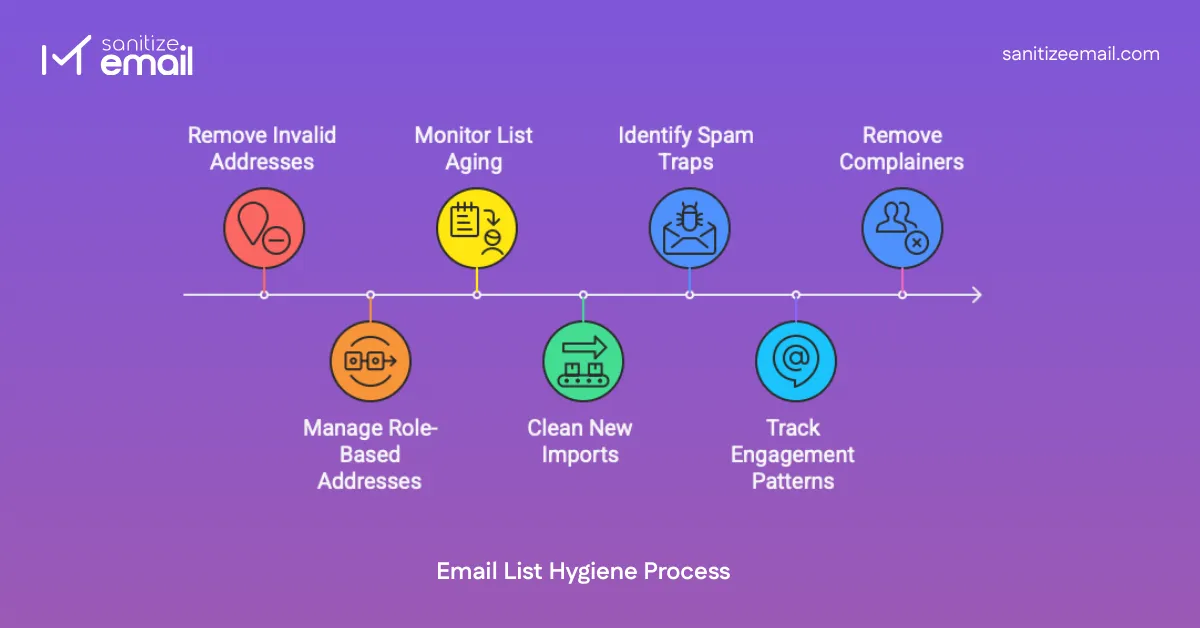
Email list hygiene includes:
A "clean" email address might technically exist and receive mail. A "safe" email address is one that:
Email list hygiene focuses on keeping addresses both clean and safe for sending.
Email lists decay continuously and unavoidably. On average, 20–30% of email addresses become invalid each year, even in permission-based lists built with proper opt-ins.
This natural decay happens due to:
There is no guarantee that a list that was clean three months ago will still be clean today. Hygiene becomes more important the more often you send, and the more aggressively you expand your list. Even a previously verified list can become risky. Run a quick free email validation check to identify outdated or risky addresses before your next send.
This is exactly why one-time verification creates a false sense of security. It's like getting your car inspected once and assuming it'll run perfectly for years without maintenance.
When you don't maintain email list hygiene:
For more on how spam issues develop, read our guide on spam email and prevention strategies.
There's no universal schedule that works for everyone, but most teams should clean their email lists every 30 to 90 days as a baseline.
The correct frequency for how often to clean the email list depends on:
The fundamental rule: The faster emails enter your system, the faster hygiene must happen.
| Use Case | How Often to Clean | Why |
|---|---|---|
| Cold email campaigns | Before every campaign | Unknown contacts have the highest invalid rates; this prevents immediate reputation damage |
| Newsletter or marketing lists | Every 60–90 days | Catches natural decay and re-engages dormant subscribers |
| Lead magnets and forms | Monthly | Form submissions include typos, fake emails, and spam bot entries |
| Event or partner imports | Immediately after import | Third-party lists have unknown quality and age |
| High-volume SaaS signups | Continuous or weekly review | Catch-all domains and disposable emails are common in trial signups |
| Re-engagement campaigns | Before sending | Old lists may contain spam traps from converted abandoned addresses |
| Purchased or rented lists | Before first use + every 30 days | Highest risk category; quality deteriorates rapidly |
This frequency approach minimizes hard bounces and reduces the chance of deliverability issues before they become visible in your metrics.
Cold outreach to people who haven't explicitly opted in carries inherent deliverability risk. These contacts:
This means cold email campaigns require cleaning before every single send, not on a schedule. Even a 2-3% bounce rate can trigger ESP warnings when sending to cold contacts.
Email hygiene problems rarely appear suddenly. They show up as a gradual performance decline that's easy to miss until it's severe.
Watch for these warning signals:
These signals usually indicate that list quality, not your copy or subject lines, is the root issue. If you're seeing multiple symptoms simultaneously, immediate cleaning is necessary.
For help identifying and preventing spam emails in your list, check out our comprehensive spam email guide.
Poor email list hygiene doesn't usually cause instant, catastrophic failure. Instead, it causes a gradual, compounding decline that becomes harder to reverse over time.
By the time these issues become obvious in your metrics, fixing them often takes significantly longer than preventing them would have in the first place.
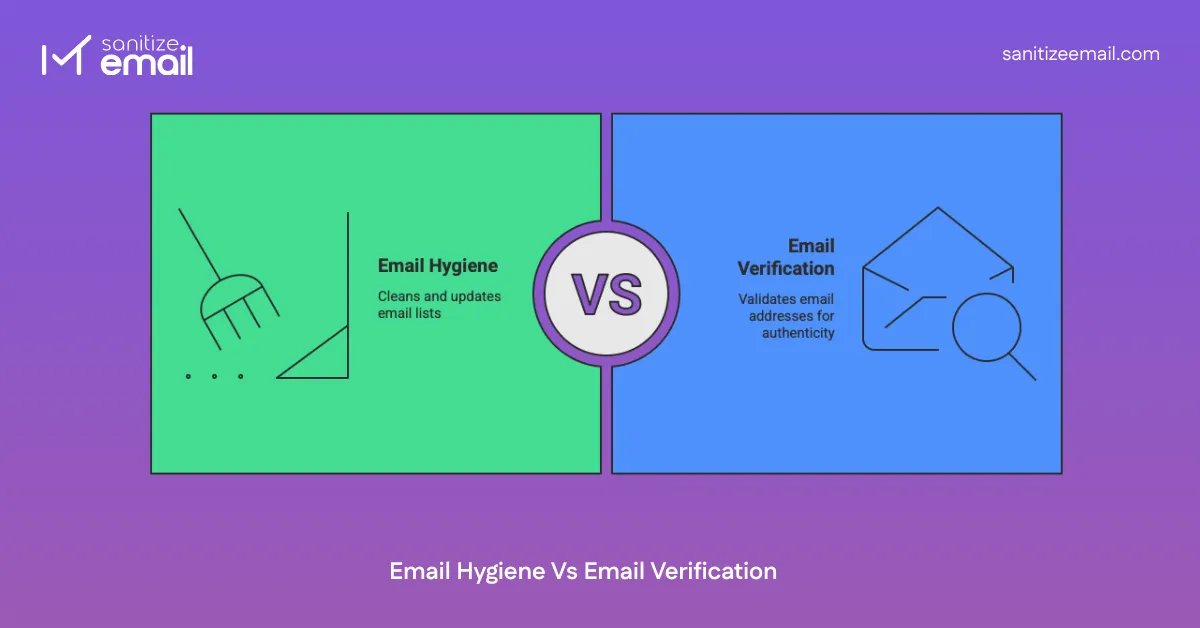
| Aspect | Email Hygiene | Email Verification |
|---|---|---|
| Purpose | Maintains long-term list quality and deliverability | Checks if an email address is deliverable at a specific moment |
| Timing | Ongoing and recurring | One-time or point-in-time |
| Scope | List quality, engagement, risk, and decay management | Technical validity (syntax, domain, mailbox checks) |
| Handles list aging | ✅ Yes | ❌ No |
| Prevents future issues | ✅ Yes | ❌ Limited |
| Identifies spam traps | As a continuous process | Before sending a campaign |
| Ideal use | As a continuous process | Before sending a specific campaign |
Email verification is a tool. Email hygiene is a strategy.
For recommendations on the best email verification tools, see our guide to the top 10 email validation tools
Situation: A B2B sales team purchased a list of 50,000 contacts, verified it once using a bulk verification service, then used it for multiple campaigns over three months.
What happened:
The problem: They treated verification as a one-time event instead of aligning cleaning with their sending schedule. The list decayed naturally, but they kept sending to progressively worse addresses.
Lesson learned: Timing matters critically. Verification and cleaning must align with the actual send date. For cold outreach, this means cleaning before every single campaign.
What they should have done: Re-verify the list before each campaign, or better yet, verify smaller segments as they entered the outreach queue.
Situation: A content marketing company maintains a newsletter list of 85,000 subscribers built organically over 4 years.
Their hygiene routine:
Results:
Lesson learned: Predictable, consistent email list hygiene protects long-term performance. Prevention is invisible-you don't notice deliverability problems because they never occur.
Key insight: They treated email hygiene as maintenance, not emergency repair. The small time investment (about 2 hours quarterly) prevented countless hours of potential troubleshooting.
Consistency and discipline are more important than complicated systems or costly automation. There are just four fundamental principles of good email hygiene that stop deliverability issues before they arise.
Never send to a newly imported list without verification first. This is your first line of defense against poor deliverability.
Why this matters: Third-party lists-whether from events, partner marketing, purchased databases, or CRM exports-always contain invalid addresses. Even legitimate sources have typos, outdated contacts, and dormant accounts that will hard bounce if you send to them immediately.
Email addresses don't stay valid forever. A list that was clean 60-90 days ago likely has 5-10% invalid addresses now due to natural decay.
Why this matters: Driving on tires you haven't checked in months is similar to sending to an aged list without re-verification; the risk isn't worth it, even though it might be okay. There are frequent domain expirations, job changes, and abandoned inboxes. What was deliverable three months ago might now be a hard bounce or spam trap ready to harm your sender's reputation.
Not all valid email addresses are worth keeping. Some addresses exist but actively hurt your deliverability and engagement metrics.
Why this matters: Gmail and Outlook are examples of inbox providers that monitor how recipients respond to your emails. Even for active subscribers, these providers will filter you as spam if 30% of your list never opens your messages because they believe your content is unwanted. Furthermore, spam traps that blacklist senders are frequently created from abandoned addresses.
The biggest mistake teams make is cleaning their lists only when problems appear. By then, your sender reputation is already damaged, and recovery takes months.
Why this matters: Email deliverability problems don't announce themselves clearly. By the time you notice bounce rate spikes or spam folder placement, you've already been sending to bad addresses for weeks or months. Your domain reputation has eroded, inbox providers have downgraded your sender score, and fixing it requires extensive reputation rebuilding.
This routine prevents problems instead of reacting to them.
If you’re wondering how to solve email hygiene problems before they hurt deliverability, the answer is not more tools—it’s consistent habits. These email hygiene best practices show how to fix common email list issues and prevent bounce-related problems before they appear.
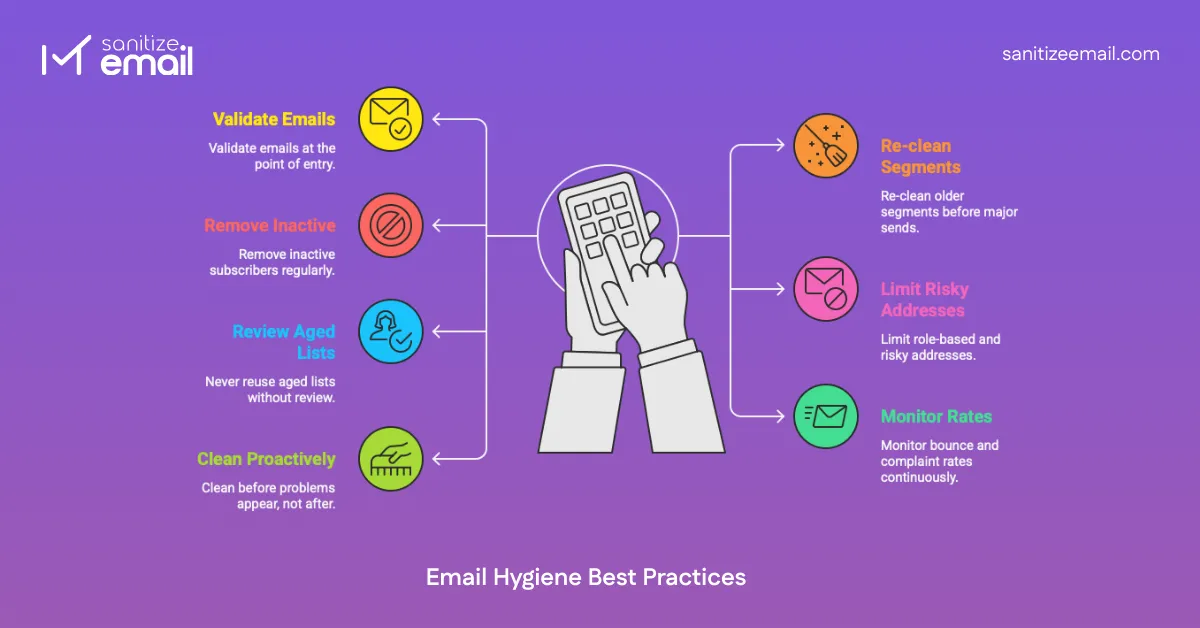
The fastest way to solve email list hygiene problems is to stop bad data from entering your system in the first place.
Always validate new email addresses at signup, lead capture, or import. Forms, events, and lead magnets are the most common sources of typos, fake emails, and disposable domains.
How this solves the problem: Prevents hard bounces and reduces future cleanup work.
Email addresses decay naturally over time. Any segment older than 60–90 days should be reviewed or re-verified before high-volume campaigns.
How this solves the problem: Fixes hidden list decay before it turns into bounce spikes or spam placement.
Subscribers who haven’t opened or clicked in months actively harm engagement metrics and inbox placement. Segment and suppress inactive users instead of repeatedly emailing them.
How this solves the problem: Improves open rates and prevents inbox providers from interpreting your emails as unwanted.
Addresses like info@, admin@, support@, or sales@ tend to have lower engagement and higher complaint risk. Keep them only when they are essential to your business use case.
How this solves the problem: Reduces spam complaints and improves sender reputation stability.
Lists collected months ago or reused across campaigns should never be sent to “as is.” Always re-verify before reuse, especially for cold outreach or partner imports.
How this solves the problem: Prevents sudden deliverability drops caused by outdated or abandoned inboxes.
Bounce rate and spam complaints are early warning signals. A bounce rate above 2% or a rising complaint trend usually indicates list hygiene problems, not content issues.
How this solves the problem: Helps you fix email deliverability issues before ESPs throttle or block your sending.
Waiting for ESP warnings or spam-folder placement means the damage is already done. Email hygiene works best as preventive maintenance, not emergency repair.
How this solves the problem: Protects long-term inbox placement and avoids costly reputation recovery.
Consistent application of these practices keeps your list safe, engaged, and deliverable—quietly protecting your campaigns in the background.
Email list hygiene is fundamentally about prevention, not reaction.
Teams that clean their lists regularly according to email list hygiene best practices don't fight spam problems, deliverability crises, or ESP restrictions-they avoid them entirely.
The core principle is simple: How often you should clean your email list depends on how fast it grows and how often you send. But the universal truth is that you must clean it regularly.
Email verification supports this process by validating addresses at specific points in time. But frequency, consistency, and discipline are what keep email performance stable over the long term.
Start with the frequency recommendations in this guide, monitor your metrics, and adjust as needed. Your sender reputation-and your email ROI-will thank you.

 Monthly plans starting at